I consider myself a historical wargamer and when this debate about realism crops up on forums and social media, as it regularly does, I'm always interested to read how people respond.
I've often heard it said that wargaming can never be realistic - no one is in danger, real bullets are not flying and there is no blood and gore. Well, all I can say is, thank goodness. That's certainly not the realism I'm looking for in my games.
Much comes from how we interpret or use the term 'realistic'. If the rules I am using give a powerful anti-tank gun a high chance of disabling a tank with weak armour, you could argue, those rules offer a realistic outcome. As gamers we resolve this action with the roll of dice and we may mark the destroyed tank with imitation smoke or something similar.
Is that realistic? Well, clearly it isn't. There is nothing in the action of rolling dice and placing markers that in any way resembles the impact of an armour piercing round on an armoured vehicle and its occupants. So, while the rules accurately reflect the likelihood of the anti-tank round damaging the tank and produces a plausible outcome that aligns with our reading of actual events, the process by which we replicate that on the table in miniature is anything but realistic.
So, if it's not real, what do we mean when we say a game is, or isn't, realistic? To a great extent that depends on what part of our games we are applying the requirement for ‘realism’. I think much of that boils down to the role that the rules assign to the player. In nearly all cases players are put in the position of command, be it the corporal of an infantry section, or the general of an army. The question I would ask is, how accurately does the game portray that role and the subordinate roles undertaken by the model figures on the table? For many the answer lies in the outcomes. We want a plausible result from a particular event. The process by which we get there - be it consulting charts, rolling dice or drawing cards from a deck are just the game mechanics to help us reach that outcome.
Perhaps then, I'm not looking for realism, what I am looking for is accuracy. I'm inclined to think that can be a more useful term to use when referring to rules that have some claim to being based on historical events.
People look for different things from their gaming experience and we each settle on what works best for us. Those gamers who are looking to model certain aspects of history on the table top will come at this from several different angles. Much depends on their reading of history and what they believe are the key factors that determine the outcome of combat. Some want the emphasis to be on command, others would prefer to concentrate on the effects of weapons systems, while others want more focus on the morale of the soldiers behind the weapons. Unsurprisingly, there are those that want a balance of everything.

Needless to say, there are some who regard this whole discussion as futile. They argue, there is no point even pretending a wargame bears any resemblance to reality, it is entirely abstract and we kid ourselves if we think otherwise. It's no more than pushing around toy soldiers, rolling dice and having a laugh.
The one issue that undermines the validity of that argument is that the military themselves engage in wargames constantly. If they bore no relation to activities in the real world that would make it a pointless exercise. Yet history shows us that is anything but the case.
Philip Sabin in his book Simulating War gives a good overview of moments when this has been the case and it's worth quoting at some length:
In the years before 1914, wargaming helped to persuade the British that a continental commitment was needed to safeguard France against outflanking through Belgium, and it also helped the Germans to devise just such a move in the form of the Schlieffen plan. Wargames showed both Germans and Russians the potential vulnerability of a two-pronged assault on East Prussia to defeat in detail, but it was the Germans who took this lesson to heart and applied it at Tannenberg.
During the interwar period, Doenitz used wargaming to develop his wireless-based ‘wolfpack’ tactics for U-boat attacks, while US Admiral Nimitz later claimed that: ‘The war with Japan had been re-enacted in the game rooms here by so many people and in so many different ways that nothing that happened during the war was a surprise – absolutely nothing except the Kamikaze tactics toward the end of the war; we had not visualized those.’
Wargaming continued apace during World War Two itself, including the notorious Japanese game before Midway in which a combination of optimistic umpiring and failure to take on board the lessons of the game blinded the Imperial fleet to the weakness of its plans.
Montgomery often played through forthcoming operations with his staff, and the Germans (as the original progenitors of Kriegsspiel) used wargaming routinely to try to offset the growing odds they faced – the Normandy invasion caught several German officers on their way to Rennes to game their response to just such an attack, and when a similar wargame in November was interrupted by a US offensive in the Hürtgen forest, the Germans continued the game and issued some of the orders for real.The decisions the military wargamers are making will only be of use if they reflect accurately the processes by which commands are given and acted upon in the real world. In other words the rules of their games need to be realistic if they are to offer any useful lessons.
While the military have a very obvious reason to want their games to be realistic, the claims by publishers of rules for the hobby would indicate this is something that they also aspire to. Warlord Games claim that Bolt Action "puts YOU in command of the most famous and brutal battles of the Second World War" while Battlefront Miniatures state that their Flames of War rules "allow you to refight the enormously varied battles fought around the world from 1939 to 1945." MMP, the publishers of the board game Advanced Squad Leader, claim their rules "..allow you to simulate practically any tactical-level engagement of World War II".
If, in theory at least, a wargame can reflect accurately actions taken in the real world, why do we find ourselves discussing if, or how, a particular set of rules is realistic or not?
I think this is because rules writing for tabletop games is a creative and subjective enterprise. The writer's challenge is to create a playable game based on their understanding of a particular period of history. In the interests of playability there are compromises and abstractions to be made, but it doesn't follow that accuracy has to be jettisoned. Simple doesn't have to equate with unrealistic. This is where the creative aspect of rules design becomes particularly significant.

Much depends on what the rules set out to achieve. We don't have to represent every factor to understand an event and draw lessons or conclusions from it. Take a fire drill in a large office building. We don't need to actually set the building on fire to understand how the alarm system responds or how long it takes to evacuate all the occupants. However fire services and building managers know enough about what happens in a real fire to run a drill that is an accurate simulation of what may happen if a fire did break out. In many ways they 'game' the event, modelling a range of possible outcomes for which a set of rules could be devised. If there is evidence indicating a 50% chance no one evacuates because they believe the alarm is false then the emergency services need to play out the different responses to a fast evacuation or a slow one. Given the reaction of the building's occupants are unknown at the time the alarm is raised and yet we know there's a 50% chance they will react one way or another, for the purposes of the drill the moment the alarm sounds we might as well roll a dice with the results reflecting the two possible responses to decide the situation they are facing. That accurately reflects the two possible outcomes were the fire to be real. While rolling a dice is not very realistic, if we base it on all the known data then it is accurate. Was the drill a waste of time and unrealistic because the building wasn't really on fire?
We can apply this thinking just as easily to wargame rules. If we take as an example a period of history where all commands were by voice or messenger, then a set of rules wanting to accurately represent the period needs a mechanism to reflect the issues all commanders faced in communicating with their subordinates. We can approach that in several ways, depending on the level at which we want the players to make decisions.

Let's take the case of a message carried by a runner. If the player is taking the role of the senior commander their key concern is that the message reaches the intended recipient and is acted upon in a timely manner. It is the outcome, not the journey, that is important. If that's the case, we don't need to follow in detail the variable speeds at which the messenger might travel, understand the obstacles they may confront, or the death or injury that may result. That might be quite appropriate for a game set at the level of the messenger, but not necessary if the player's role is that of the commander. We only need to know if the message was received and understood by the recipient.
Much like the example of the fire drill, if experience or history tells us say that 1 in 3 of all messengers failed to deliver their message, then looking at this solely from the commander's perspective we could resolve the outcome by rolling a D6, where a roll of 1 or 2 tells us the message failed to make it through. While this single roll of a dice could be considered accurate in terms of reflecting the chance the message is received it is an abstraction in terms of game design, however that doesn't make it invalid as a reflection of reality. What would be inaccurate or unrealistic would be to have a game mechanic whereby the commander can communicate across the battlefield without the need to send a message, or one that assumes that every message arrives at its destination with perfect timing, to be understood and acted upon exactly as you the commander wished. It strikes me that would be far less realistic than the roll of a D6 to determine the outcome.
Like writing history, every rules writer has a distinct view of where the importance lies. Is it the weapons themselves or is it more about the soldiers behind them? Is firepower the most critical factor or is morale more important? What about leadership? Are battles won because of great generals or is that determined more by the training and discipline of the troops under their command? Military historians and theorists cannot always agree, so little surprise that rules writers come at this from different perspectives.
In the 1970s and 80s many wargame rules focussed on the impact of weapons. I’m certain that at the time it had a lot to do with trying to elevate the perception of miniature gaming above simply ‘playing with toy soldiers’. Much time, energy and research was focussed on producing charts and tables to reflect the likelihood of weapons hitting at various ranges and the damage they might inflict should they strike their target. Debates about realism often centred on these aspects and rules that failed to factor in the varying attributes of different weapons to the player’s satisfaction were often regarded as unrealistic.
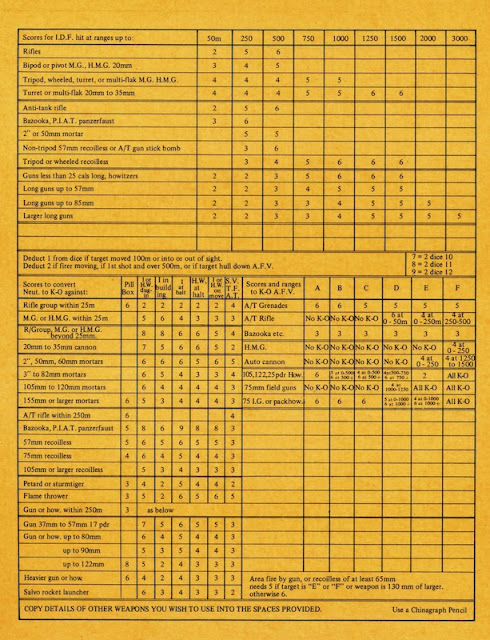
Yet it is much easier to assign a degree of accuracy to mechanical factors because they can be measured and verified. We know the maximum speeds of most vehicles, there is copious data demonstrating the penetrative power of armour piercing rounds on different thicknesses of armour, we know the time it takes a trained soldier to load a smooth bore musket. Armed with this sort of data we can create a set of rules that deliver reasonably accurate outcomes for these activities.
What is much harder to measure and assess is human activity which introduces more unreliable and complex sets of actions. While we can calculate the likelihood of an AP round piercing a tank's armour it is much harder to put a fixed response to the way the crew will react to being shot at by such a powerful weapon. Other more variable factors come into play like bravery, experience, training and fear. What we do know is that the response is likely to differ, with a myriad of factors coming into play at any one time. In fact the one thing we probably know for sure is that the response won't be mechanical, it is far more likely to be emotional. In other words we can't predict with certainty what the reaction will be other than to say it will vary with individuals and in different ways at different times. While it won't be entirely random it will be harder to predict. I think most of us would agree that to assign an identical response by all humans in response to a similar event is unrealistic.

A set of wargame rules that treats the soldiers on the table like robots is far less likely to reflect accurately the response of humans to the situations they might face than one that factors in a more variable response to a wide range of events and circumstances. Soldiers told to advance across an open field towards buildings known to occupy the enemy are likely to respond in different ways. Inexperienced troops may not show enough caution and advance recklessly, yet they could also show excessive fear and barely move at all. Hardened veterans may not display the recklessness that comes with inexperience but they may show the caution that comes with experience. The challenge for a commander is managing a response to all these variables and not least being unsurprised when they do occur.
Can that be reflected on the table top with any accuracy? Again it depends on the level of abstraction as much as your reading of history and psychology, but I would think to not do so at all would be the most unrealistic response.
So, while a wargame can never recreate the reality of actual warfare on a table top, it is possible to try to reflect more accurately the outcomes of decisions that are made on the battlefield. Yet it doesn't follow that a realistic or accurate set of wargame rules must be an overly complex simulation. The skill and art of the rules writer is to distil the key elements down into abstractions that make them straightforward game mechanics. If successful then they give the commander - you, the player - a much better feel for the decisions and issues faced by your historical counterpart.
If it is at all possible to say that historical wargames can be realistic it must then beg a different question to the one I started with, which is, what is it that can make a set of rules that claim to be historical unrealistic?