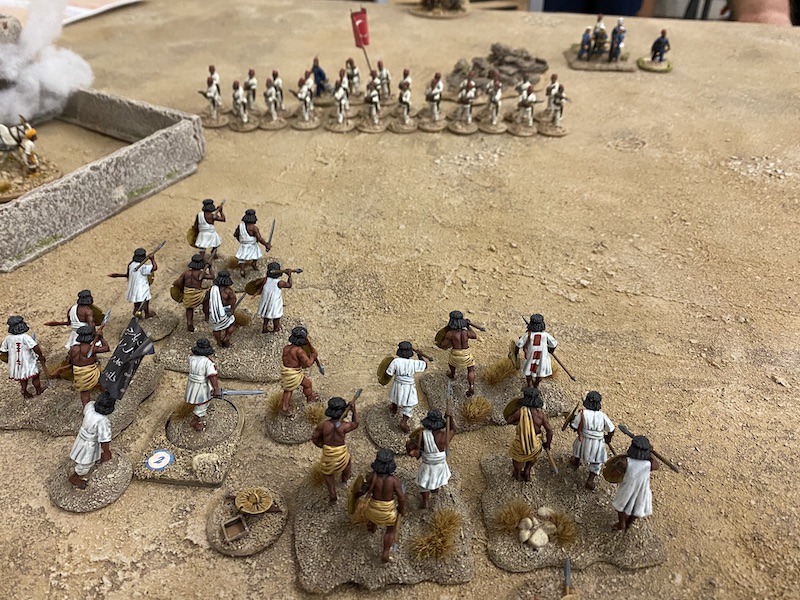
A slightly belated post on my games at Cancon this year. Cancon is Australia's biggest gaming convention and takes place every year in Canberra over the holiday weekend that falls around Australia Day on January 26. This year, as I have done for the last four years, I ran participation games in the Lard Zone.

Whereas most of Cancon is tournament focused, the Lard Zone aims to offer players an opportunity to pick and mix from a variety of Too Fat Lardies games, with the focus on participation, rather than competition. Cancon is a big event with multiple games and tournaments running over three days. The Lard Zone occupies one corner of this hall, one of four halls housing game events.

Last year, I ran four games of a scenario set on Saipan in 1944. As is usual for me, it was played in 20mm using the Chain of Command rules (more about that game in this post). Pleased to say, that scenario has since been published in issue #138 of Wargames, Soldiers & Strategy magazine.

This year, I stayed with Chain of Command and 20mm, but the scenario moved to the eastern front and the fight for Konigsberg in East Prussia in early 1945. Here is the table set up ready for the game on the first morning. The terrain sits on a 6'x4' homemade mat. I like to have this on a larger table, as that allows players to keep the other game related paraphernalia off the actual terrain itself.

The hall filled quickly. Between all the players in the various events and those just at Cancon to buy from traders and stroll around the tables, the volume rose significantly. By the end of the second day my voice had paid the price. The only solution would seem to be copious amounts of cold beer in the evening.

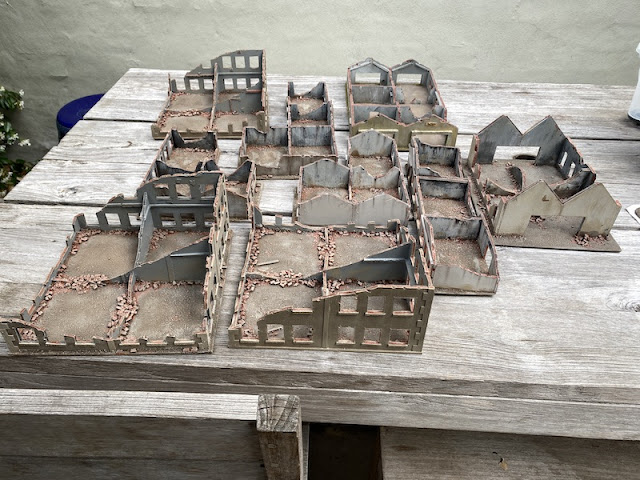
Entitled 'Twilight of the Reich' the scenario was an opportunity to use my ruined city terrain and incorporate many of the new rules in CoCv2. The terrain itself wasn't created specifically for this project. I've been building it up over time. Initially, some was created for games using Crossfire, when I returned to miniature gaming in 2015.
It was also a chance to use the Russian SMG platoon as it is listed in the CoCv2 rule book. The aim was to form a force with supports that aligned with the Soviet Assault Brigades that were in use with 11th Guards Army at the time of the attack into Konigsberg. It was a great opportunity to use my AB Figures' Russian collection.

The sorts of choices for support units included a Scout section, flamethrower team, SU-76, T34/76 and ISU-152.


The German defenders in this part of Konigsberg were Volksgrenadiers. At this late stage of the war their force morale is brittle, but they were well armed with StG44 assault rifles and plenty of panzerfausts. Once again, the miniatures are from AB Figures.

Their support choices included things like a Volkssturm section, StuGIII and a panzerschreck team. The Volkssturm miniatures below are from Wartime Miniatures.


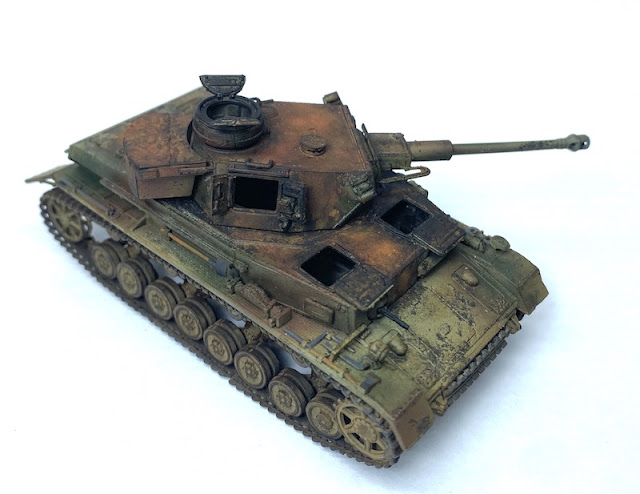
This was designed as an Attack & Defend scenario, as per the v2 rulebook. For that I needed two suitable objective markers. To set the theme I chose a couple of models that would fit the period and place - a broken down Opel Blitz omnibus, a lovely kit from Roden, and, a burnt out PzIV, a conversion using a Dragon kit.

As luck would have it, Richard Clarke, from Too Fat Lardies, was going to be in Sydney visiting his daughter in mid January. He didn't plan on a trip to Cancon, but did have time for a game one evening in Sydney. That was perfect timing to have him playtest the scenario with Dave, my regular Chain of Command opponent. The table was not the final version, as I only needed to have the key buildings in place, but it gave me an important feel for how the scenario could be fine tuned.
When it came to the table at Cancon I gave it the full treatment, dressing it with rubble and other scatter terrain. More about making that ruined city landscape in
this post.
I ran four games using the same scenario, with two games each day on the Saturday and Sunday. To speed up the start of each game I set the force morale in advance and players were given a choice of three support options for their chosen side. I printed these out on to cards to make the whole process quick and easy to understand. Players were asked to select one of the options, keep it secret and hand me the card. That way their opponent would know what the options might be, but not which one was selected until the units appeared on the table.
It was interesting to see how each game unfolded and how that was influenced by the support options that were chosen. The combination of a T34/76 and a Scout section proved the most popular with the Soviet players, mainly because it allowed the use of the Scout special rule where they can use a team as a jump-off-point. They could also use the T34 for the Russian characteristic of
Tankodesantniki, which similarly allows an AFV with no shock to act as a jump-off-point. Although, in the end, no one actually used that tactic in any of the games played.
The German players tended to favour taking the option for a StuGIII. This allowed use of
Pakfront! one of the new German characteristics in the v2 rule book.
This often resulted in opposing tanks contesting the various objective markers and trying to stalk each other amidst the narrow confines of the ruined streets. Nail-biting for the players and very entertaining to watch as the game organiser.
The Volkssturm made an appearance in only one game. There they took up a secure position to guard one of the objectives and not much was asked of them. Probably just as well.
Objective points often changed hands several times in the course of a game amidst bitter hand-to-hand fighting. All of the elements you'd expect to witness in a city fight.
One Russian option included two SU-76 and an infantry flamethrower team. While the SU-76s provide useful HE support, their armour is paper thin. On the other hand, the flamethrower team could operate to deadly effect - if it can come close enough.
In one game, a plucky SU-76 stood its ground to duel with a StuGIII.
Hardly a fair fight, but it survived for longer than either player was expecting. Until it didn't. Exploding in flames and inflicting casualties on a nearby friendly SMG section.

It was good to see all of the scenarios hotly contested, but played in the right spirit. The game attracted a fair bit of attention from passersby, with plenty of compliments on the terrain.
20mm games rarely make an appearance at the convention, so it was great to fly the flag for that scale and for Chain of Command.
Too Fat Lardies very kindly gave all the tournament organisers two bespoke Lardy dice towers, featuring their Pie and Pint logo, made courtesy of Battlefield Accessories. Both saw a lot of use.
While my regular CoC opponent Dave helped with playtesting, he had his own games to run at Cancon. Here he is (in the centre) running participation games of Infamy, Infamy. He was intrigued that several different people asked if he was '
the Dave' from the Tactical Painter blog. So, here he is, the face behind the name.
Happy to say that was another very successful Cancon. I was pleased with the way the scenario played out. Several players travel quite some distance to attend and I feel game organisers carry a fair degree of responsibility to ensure they provide participants with a good experience. With three hours to play each scenario I'm always concerned the games may run over time, but all came to satisfactory conclusions within the allotted time. Naturally, it was really gratifying to receive so much positive feedback on all aspects, but particularly the terrain.
As always, it was good to see familiar faces at the event and big thanks to all those who participated in my games - Mark Chandler, MJ Carrick, Ben Fiene, Rowan Coker, Jeremy Cullis, Steve Preston (at very short notice, so thank you), Barnaby (you know who you are) and Damien Browne. Lastly, and most certainly not least, a huge thanks to Peter Rossetti, the organiser of the Lard Zone. As I said to him at CanCon, I don't think he quite receives the recognition he deserves for the excellent job he does. It must be like herding cats at times, a task at which it seems he has come to excel.