Showing posts with label Armourfast. Show all posts

Tuesday, 5 March 2024

Second World War Early War German armour in 20mm

I don't have a collection of German infantry for the early war (well, not yet anyway) but for various reasons I seem to have gathered a small collection of armour for those years. At this stage I'm probably more interested in playing 1942 on the eastern front and a part of this collection has been put together with Fall Blau and the Stalingrad campaign in mind. It’s by no means comprehensive. I’ve tended to acquire models as I’ve needed them for other games or campaigns. 

First though, we start at the very beginning with a PzIa. The two below are from S-Models. They were bought originally for my Sino-Japanese war project but somehow I’d acquired more kits than I needed, so when we came to play the Many Rivers to Cross the campaign set in the Netherlands in 1940 I made these up and painted them for the Germans instead.
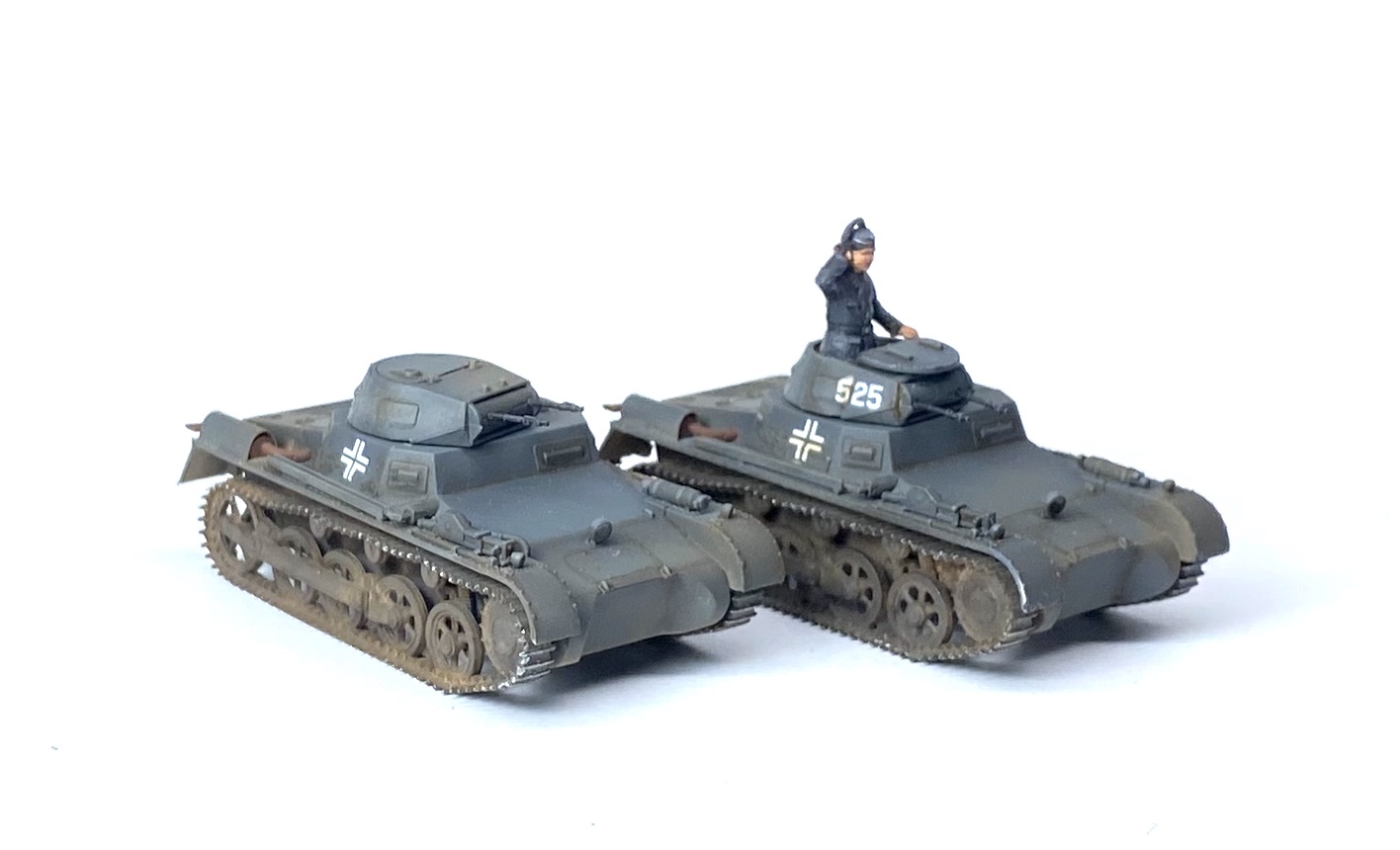
They saw action in several games in that campaign.

Not long after I made them I came across the picture below. While my tanks may appear a slightly lighter grey than those in the picture I am pleased with the way my weathering matches up, in particular the way the running gear and tracks are noticeably dustier than the hull and the turret.

While I've been fortunate to visit many museums and see a fair amount of German armour the one tank that has alluded me so far has been the Panzer I. I suspect not many survived. 

The Pz38t was one of a couple of Czech designs that saw service right up to the Barbarossa campaign. Not a bad tank for its time with a decent mix of speed, armour and armament although by 1941/42 it was obsolete. That said the chassis was to see future use. This is a Pz38t from the Plastic Soldier Company set. While it's a sturdy model I think PSC have gone a bit overboard with detail like the rivets which appear over-scale. Unfortunately I've only exacerbated the issue by highlighting them with the paint job.

Here is one in the collection at the Australian Armour and Artillery Museum and while the rivets are a noticeable feature of the tank they are not as pronounced as they appear in the PSC models.

Before I returned to miniature gaming I made a lot of models in 1/35 scale and the Pz38t was one of those. As you can see with this kit the rivets are more in scale and closer to the look of the original tank.


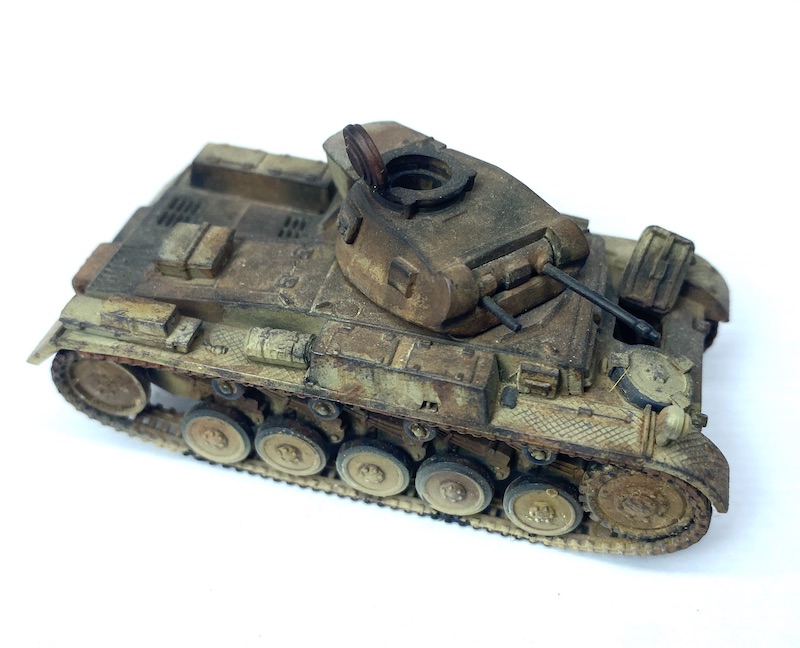
Although never intended as a main battle tank the PzII took part in numerous operations in the early war and were still present in some units as late as 1942. This is another from S-Models and was made with our Netherlands 1940 campaign in mind.

Unlike the Panzer I, I've seen several PzII in various museums. The one below is at the Tank Museum at Bovington and it's in the early war two tone brown and grey colour scheme.


There is another in the Canadian War Museum's fine collection of vehicles and AFVs.


The Musee des Blindes in Saumur also has one.


The main battle tank of the panzer divisions during this period was the PzIII. These are two Ausf G from S-Models.


There is a PzIII Ausf J at the Australian Armour and Artillery Museum.


Also one at Musee des Blindes.

This is a later model ausf L from one of the PSC sets.

The Panzer IV originally provided infantry support with a short barrelled 75mm gun. By 1942 the design was taking on a much more prominent role and was up armoured and up gunned. These are both Ausf D versions from Armourfast.

The Armourfast models are inexpensive and quick to build but they do suffer from a shortage of detail. I have several kits from them and I've often found with a bit of additional detail like stowage they come up well. Unfortunately these are one of their most basic kits and I think have the least detail I've seen on any of their models. The AB crew figures are my best attempt at improving them.


The Australian Armour and Artillery Museum has an Ausf D.


Later models were up gunned and replaced the Panzer III as the main battle tank of the panzer divisions in the mid years of the war. This is an Ausf F from PSC.


Those later models are covered in a second post on the blog featuring late war German armour. I chose February 1943 (the time when German tanks went from grey to a base colour of dark yellow) as the watershed to cover the armour of the later part of the war.

The history of assault guns in the Wehrmacht is interesting and talks much to the rivalries within the army. The StuG III Ausf A provided close fire support for the infantry and after much internal wrangling was not classed as part of the tank force but rather of the artillery. Crew members did not wear the distinctive black uniforms of the panzerwaffe with the pink piping on collar and shoulder patches, instead they wore the artillery uniform with its white piping. These two StuG III Ausf A are from Trumpeter.

They have one of these early variants at the Australian Armour and Artillery Museum.


A more rare assault gun, also mounted on the same chassis as the StuG III, was the Sturm-Infanteriegeschütz 33B which carried the sIG33/1 gun. Only twenty four were made and the first twelve were sent to Stalingrad. The second batch of twelve were also intended for units serving in Stalingrad but by the time they were ready for delivery the 6th Army had been surrounded and so they were assigned to other units. Given this early war collection has been put together with the fighing in Russia in 1942 in mind, this model from Armourfast was an addition I couldn't resist.


Manufacture of the chassis for the Czech Pz38t continued after the original tank was considered obsolete and came to serve many uses, one of these was as the chassis for the Marder series of self propelled guns. The PSC sets give you the option to make up the Pz38t tank or to make them up as two version of the Marder III tank destroyer.


One of my initial reactions to the models was to think that once again PSC had gone over-scale with the muzzle brakes on the guns, although having seen the two Marders pictured below at the Musee des Blindes I'm less inclined to think that's the case.


The eight wheeled Sdkfz231 Schwerer Panzerspähwagen series of armoured cars were intended mainly for reconnaisance units. The Plastic Soldier Company make a set that allows you to build several of the variants, including the one below armed with a 20mm autocannon.

And one with an open top with the short barrelled 7.5cm gun.

They have the very similar looking later model Sdkfz234/4 version in the Tank Museum at Bovington.

While the Sdkfz 251 half track might be an iconic German vehicle they were not as numerous as one might imagine nor available in the sorts of quantities the Wehrmacht would have preferred. Nonetheless they were present in several panzer divisions from 1939. The Australian Armour and Artillery Museum has a variant of one of these that was built in Czechoslovakia after the war.


The Musee des Blindes have an engineer variant.


These models below come from the Plastic Soldier Company sets which allow for a few variants. I've kept mine mostly as Sdkfz251/1.


They supply a figure manning the light machine gun. It is easy to hold him in place when the MG is placed in the gun shield and so I haven't attached him permanently so I can remove him during a game.


It's also possible to create the Sdkfz251/10, the platoon leader's vehicle, which mounted the 3.7cm anti-tank gun.


At the moment these have given me enough to play several early war games and given us the vehicles we needed to play the Many Rivers to Cross campaign in the Netherlands. I suspect the collection will grow on an 'as needs' basis but it's always very satisfying to think about playing a game set in a particular theatre and to know you already have the models ready and waiting.....

Sunday, 11 February 2024

Telling a story with vehicle wrecks

I think vehicle wrecks are like casualty figures, they are visual cues to the unfolding narrative of any game or campaign. The more that I record my games here on the blog, the more I see how well those elements help to tell the story and make the experience more immersive. One of the advantages of playing the Second World War in 20mm is the abundance of models and their relative low cost when compared with 28mm. It means I can afford to turn a few into wrecks without breaking the bank, like the PzIV below, a plastic kit from Dragon.

The first wreck I made was a small Panzer II using the old Matchbox kit (see below). I opened up the driver's hatch and added a very simple interior, but other than that this is the kit as it comes out of the box. 


The second was a T34 and I decided to try something more ambitious. The old Airfix kits can be picked up very cheaply and I decided to make this one with the turret blown off. The interior elements were scratch built, but not following any precise plans, I just wanted to give the impression of cluttered debris within the tank hull and turret. All I used were odds and ends from the spares box and pieces of plastic card.

With the turret blown off it made sense to have surrounding debris and so I mounted this one on a small base.


When we planned the 29, Let's Go! campaign I had a feeling we might need a wreck of a Sherman - the Americans can field several of those and it occurred to me there was a good chance we'd replay on a map where one had been destroyed. I had a spare M4A3 from one of the Armourfast sets that was perfect for the job.

Generally I've found open hatches and a burnt out effect on the exterior are two simple ways of conveying the tank's status.


As it turned out, it didn't end up making an appearance in that campaign but I did find a use for it in Operation Martlet where it served as a knocked out British tank.

Operation Martlet also inspired a knocked out PzIV. The core German panzer grenadier platoon starts with one attached. There was a good chance that might also be destroyed and we would play another game on the same table. I picked up a very nice kit from Dragon that enabled me to make one with most of the hatches in the open position without having to undertake any conversion or cutting of parts.


In all cases the painting method is essentially the same. The base model is sprayed with brown and black tones.


Once dry the model is sprayed with AK Worn Effects.

Once that is dry the tank is sprayed in the colour it would have been prior to being knocked out. Once that is dry you lightly wet the paint and then rub at it with a coarse hair paint brush to expose the colour underneath. It's a surprising simple yet effective technique. You can see this in more detail in this post about making the wrecked T34.

Broken down vehicles or those out of fuel also add to the narrative. The story of a retreat is full of pictures of vehicles abandoned by the side of the road. When we played the Ruckzug campaign I thought that was a perfect opportunity to make up a bus that I had bought with just such a project in mind.


I have a set of plastic panzer crews from Orion and a few of them are in overalls and look like mechanics. I thought a few of them would provide the perfect little vignette to work with the model.


I based them separately so that they can work with the model or not depending on how I wanted to use it.


Here it is in one of the Ruckzug campaign games:

A Japanese Isuzu truck model from IBG came complete with an engine and it seemed a shame not to do something similar with that. In this instance I haven't come up with any appropriate Japanese figures for mechanics but I think with the bonnet up and the driver's door wide open it still tells its own story.


Is this all a bit of an indulgence? I don’t think so. I love games with miniatures because they offer a rich visual narrative. Our figures, models and terrain are the props and performers on our little stage, so we can never have enough.