This continues the posts on my German Second World War 20mm collection. The infantry can be seen in this post on the Heer and this one that covers Volksgrenadiers, Volkssturm and the SS.
Here I focus on German armour for the last few years of the war. From February 1943 all German tanks were to be painted in a base coat of dunkelgelb (dark yellow) and so this change in colour scheme is a useful watershed moment that I can use to differentiate the later period of the war from the early years.
Units and crews had the option to apply two additional camouflage colours over the base of dark yellow in patterns as they saw fit. In most cases the paint was supplied as a paste. It would be diluted with petrol or another solvent and spray painted using airbrushes or applied by hand. Later in the war some tanks would come fully painted from the factory but in most cases there was no standard pattern and so you will often see a wide variety of painting styles and colour combinations even within the same unit.
By 1943 the Pz III and Pz IV had been upgraded with better armour and armament but this was the year where the next generation of German armour would start to be seen in increasing numbers as German industry responded to the challenge of facing superior Russian armour on the Eastern Front. The Battle of Kursk in July of that year would see the last use of the PzIII in large numbers and the arrival of the PzV, the Panther.
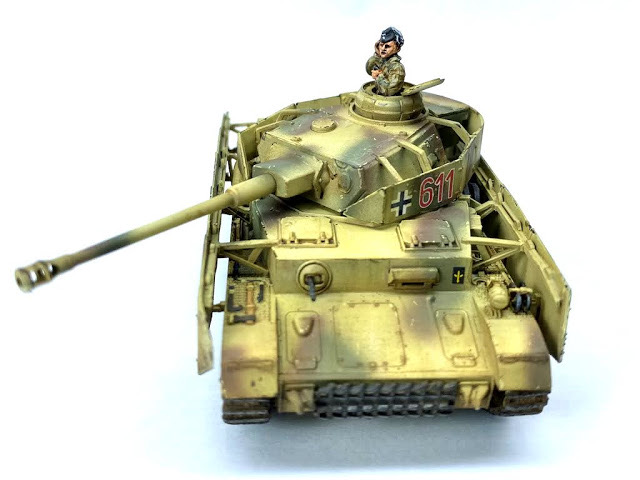
The PzIII and the PzIV would be seen in both the earlier grey colour scheme as well as the later one. I've used the versatile sets of kits from the Plastic Soldier Company (PSC) to cover earlier and later models. Here is a PzIII Ausf L with a crew figure from AB
The PzIII was also modified and kept in service as the flamethrower equipped Flammpanzer. This model is from the same PSC set, which comes with parts to make this variant.
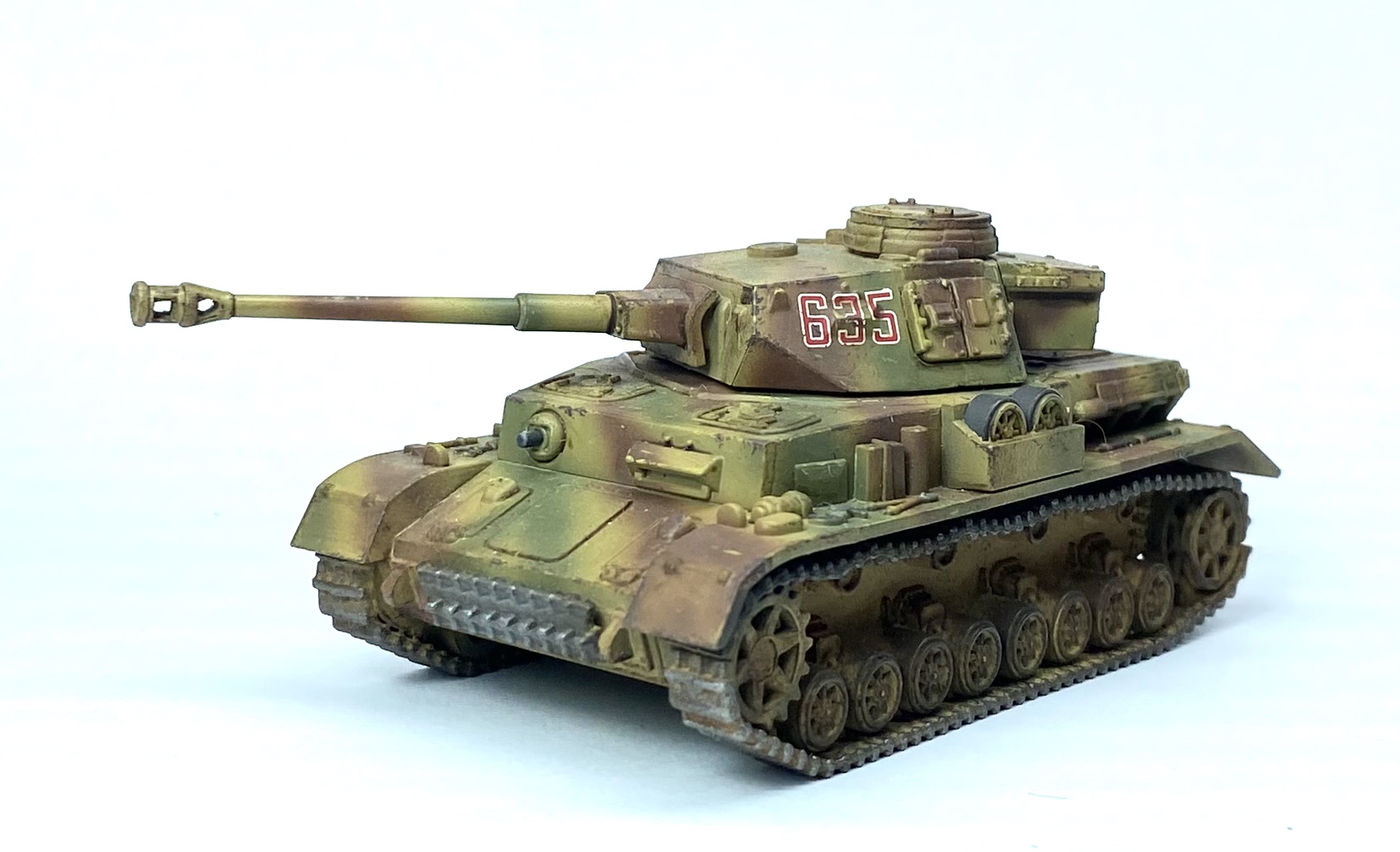
The PzIV would see service throughout the war. Again I've used the PSC sets as a starting point. This is the PzIV F with the short barrelled 75mm gun from PSC.
From the same set from PSC this could work as an Ausf F2 or Ausf G.
Here is a PzIV Ausf G at the Australian Armour and Artillery Museum.
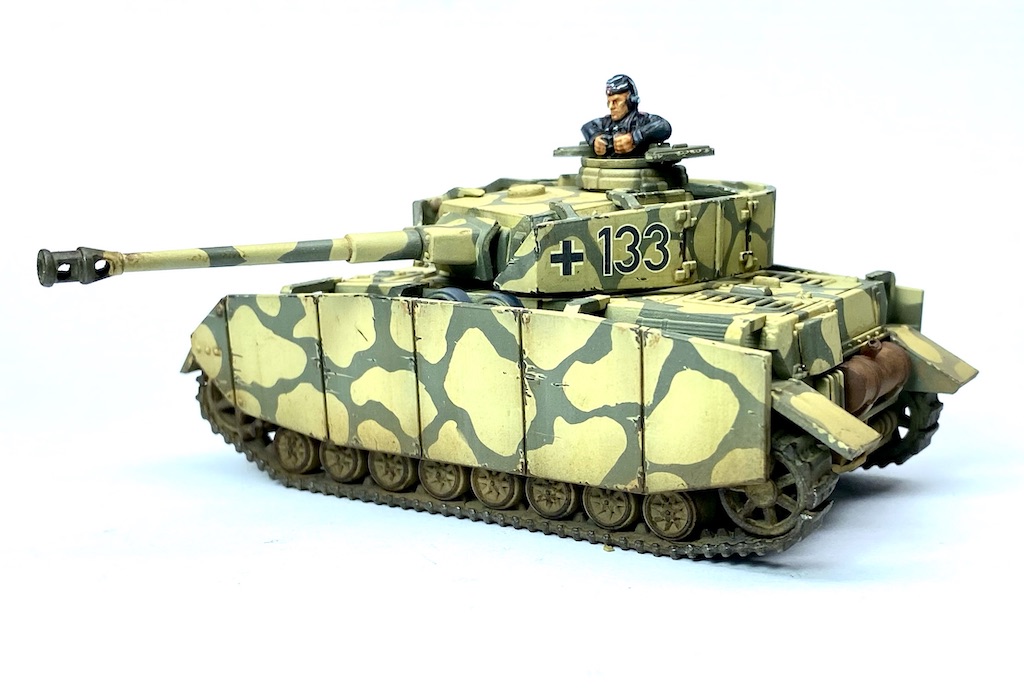
PSC also do the later variant Ausf H with schurtzen armour.
While the PSC kits are good value and are sturdily built for gaming I do find some of their detail a bit clunky and over-scale. I guess it's a compromise between form and function. Revell do a lovely version of the PzIV H and while the finer details are not as sturdy as the PSC version it does make up a very attractive looking model. Here I've added a crew figure from AB.
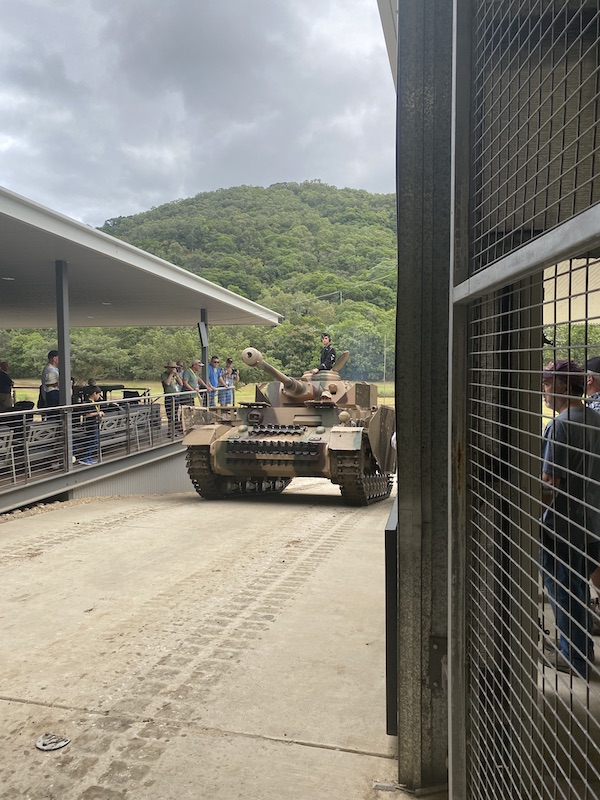
It's not very often you have the opportunity to see a working PzIV so it was great to have the chance to see one at the Australian Armour and Artillery Museum.
As good as it was to see it at a distance with other tanks of the same era, nothing beats having one rumble right by you, as this one did.
There is a PzIV with the same wire mesh schurzen at the Musee des Blindes, unfortunately the lighting wasn't great for photography.
PSC also do a set of Panthers with zimmeritt. Here is one with a PSC crew figure.
I also have a lovely one from Revell, this time without zimmeritt. The crew figure is from AB Figures.
The Panther at the Tank Museum at Bovington has a more unusual camouflage scheme and doesn't have zimmeritt.
I've based the camouflage for one of my Panthers on this one at the Canadian War Museum
The scheme is very similar to the one at the Musee des Blindes.
It's rare that you have the chance to see a working Panther but the Australian Armour and Artillery Museum has one. While it's an original Panther with an original Panther engine, this one was restored using parts from several Panthers.
The Panther chassis was used as the base for the formidable tank destroyer, the Jagdpanther, mounting an 88mm gun. The model below is a plastic kit from Revell with a crew figure from AB Figures.
I've seen a few surviving Jagdpanther. The one below is in the collection of the Australian Armour & Artillery Museum and inspired the camouflage scheme on my model.
This one is in the collection at the Tank Museum at Bovington.
Lastly, the one below is in the Musee des Blindes at Saumur.
The Tiger I below is also from Revell. Normally much pricier than the PSC models, I was fortunate to pick this up in a hobby store sale. It's a beautiful kit that gives a very good rendition of the Tiger, although given it's an Ausf E it's a shame it comes without zimmerit. The crew figure is from Orion.
I've gone for a camouflage scheme similar to the Tiger 1 at the Musee des Blindes, which unlike the Revell kit does have zimmerit.
This one at the Australian Armour and Artillery Museum is an earlier variant and without zimmerit.
The Tank Museum at Bovington has the very well known Tiger 131 which was captured in Tunisia.


Given most of my gaming at this scale is at platoon level there isn't much call for tanks like the Tiger II, so you are no doubt wondering why I have two. These are from Pegasus Hobbies and come as a set. I'd bought them on an impulse in a sale and they sat unmade for several years. As you can see that's no longer the case, although I have to confess they are yet to see action in a game.
They really are very big tanks and I've managed to see a couple. The one below at the Tank Museum at Bovington (and that's my youngest son with a metal model of one).
The other is at the Musee des Blindes.
The Germans made use of a number of different chassis to make tank destroyers and self propelled guns. This PzIV L/70 is from Hasegawa with a crew figure from PSC.
They have one at the Australian Armour and Artillery Museum.
They also have one at the Musee des Blindes.
This earlier variant at the Musee des Blindes has suffered a catastrophic armour failure.
If you look carefully just below the mantlet of the main gun you can see an armour piercing round that has failed to penetrate.
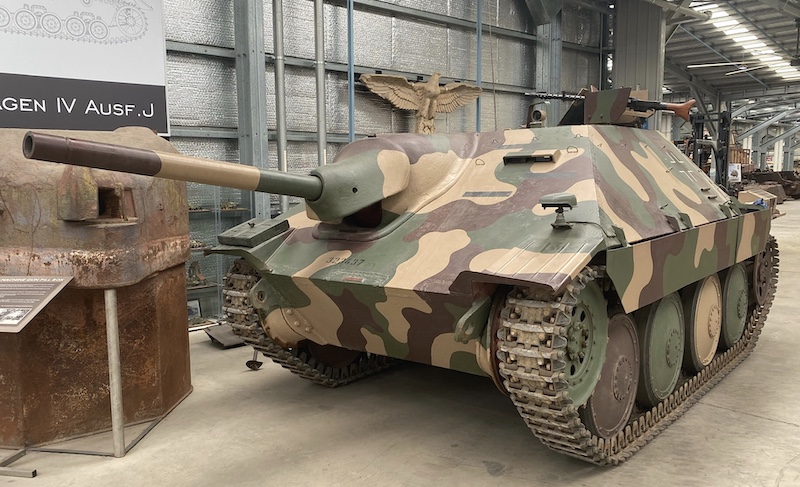
The Hetzer made use of the obsolete Pz38t chassis and this kit is from UM.
It's not a particularly attractive vehicle but there is something about its small, compact nature that makes it quite appealing. The one below is at the Musee des Blindes.
The Australian Armour and Artillery Museum also have one in their collection.
AB Figures do a great set featuring a German tank crew bailing out. They come in very useful when taking pictures for the AARs of our games. Here they are with the UM Hetzer.
Here are two Marder III Ausf H from PSC. This is an option that comes as part of their Pz38t set. Like the Hetzer it uses the same chassis. The crews are various AB figures.
The last variant of the Marder III was the Ausf M, which was a major redesign and much improved vehicle. With the engine moved to the centre it allowed for a proper crew compartment, offering much better protection. The model below is a plastic kit from UM out of Ukraine, the crew is from AB.
The Marder III came in three different variants and the Musee des Blindes has an Ausf M and the earlier Sdkfz139 versions, but not the Ausf H.
The Plastic Soldier Company model suffers from the slightly overscale details that plague many of their kits. I can live with some of these as they are practical for gaming, but some, like the rivets, do seem a bit excessive (and unnecessary). Here's a side by side comarison of the UM Ausf M and the PSC Ausf H.
The StuG III G was produced in significant numbers and as the war turned against Germany they proved a cheap and effective anti-tank platform. These two are from PSC.
I added some home made foliage to one using rubberised coconut fibre and leaves from Noch.
The PSC set also includes the options to make the StuH 42 variant with a 105mm howitzer as main armament.
There are both versions at the Musee des Blindes, the one below is the StuH 42.
The other is a StuG III with the 75mm gun.
There is an earlier version with the 75mm gun housed in a more square mantlet at the Canadian War Museum, but it is not in the best shape. It was recovered from a battlefield in Italy after suffering considerable damage.
There is the StuGIV variant at the Australian Armour and Artillery Museum.
I think it probably goes without saying that this post is a work in progress and the collection is bound to grow larger over time. In fact, looking at my stash of unmade models then I can say that's a certainty.
While I don't have a collection of early war German infantry I do have quite a few vehicles and AFVs for the period and I will put together a separate post on those in the near future.





.jpeg)