Showing posts with label s-models. Show all posts

Thursday, 12 February 2026

More 20mm, means more Second World War

I found January a very productive period for a number of different projects, not least of which was more 20mm for the Second World War. I painted quite a few figures and, to give myself a change of scene, I made up a few plastic kits that had been sitting in the stash. Among those was a Marder III Ausf M from UM and a Jagpanther from Revell. The latter a bargain I couldn't resist at a Bring & Buy.

I have a few kits from UM and they can be fiddly at times, but no matter how frustrating, I'm always happy with the end result. The Marder III is no different and a crew from AB Figures sets it off nicely.


The Plastic Soldier Company Pz38t set allows you to also build two earlier versions of the Marder, but not the later Ausf M. It's noticeably different, because it involved a major redesign that saw the engine relocated to the middle of the vehicle, thereby allowing a proper sunken cab to house the crew and give them better protection. Here's the UM Marder next to the PSC version of the Marder III Ausf H (also with a crew from AB).


Here you can see clearly how the earlier Ausf H retains the original chassis of the Pz38t and simply replaces the turret with the new gun mounting and shield. Not the most secure of positions for the crew to work from if under fire.


Revell have always made good 1/72 kits and while the Jagdpanther is hardly a new kit, it produces a very fine finished model. Once again, I've added a crew figure from AB.

The kit came moulded in black plastic, a strange choice for a number of reasons but not least because it's an awful colour to work with. As with the UM kits, this becomes irrelevant once it's all come together and has paint on it.


I was able to fill out the US Marine force with figures and weapons teams that aren't covered in the Eureka range (which make up the bulk of my Marine squads).

To fill those gaps I've acquired figures from a couple of other ranges sold through Grubby Tanks - Britannia Miniatures and Kellys Heroes. This can occasionally be fraught with danger, as not all ranges work to similar sizes or sculpting styles, but I'm reasonably happy with how this has worked out. 

One of the issues with the Grubby Tanks website is that many of the ranges have no pictures of the figures. This was unfortunate because I placed an order for 50cal MG teams from the Britannia range and what I actually received were M1917 water cooled MGs. While they certainly look the part for a sustained fire MG role, they are not the heavy calibre of the 50cal, but they will have to suffice for now. Using the dedicated loader figures and a couple of others, I can make up a five man team.


If I have an issue with the Britannia Miniautres figures, it's to wonder why they've been sculpted with backpacks? I would imagine the operators would most likely have removed these in order to operate the weapons more efficiently. It's not a big issue, but it does seem a bit odd.


Originally, when I was ordering the initial batch of figures from Eureka, I didn't look too closely and made the quick, but incorrect, assumption that their mortar teams must be 60mm mortars. They are in fact 81mm M1 mortars. 


The lack of M2 60mm mortars has been addressed by using sets from Britannia Miniatures. The difference in size of the 60mm mortars from the Eureka 81mm mortars is a stark reminder that I should pay more attention when ordering figures.


I added a couple more bazooka teams, one from Britannia Miniatures (on the left), the other from Kellys Heroes (on the right). Once again, the Britannia figures are fully encumbered with backpacks, while the Kellys figures look more casually dressed and more fitting to a combat role.


A couple of figures with satchel charges will always come in useful. One from Kellys Heroes and another from Britannia Miniatures (I don't think I need to tell you which is which!).


Frankly, it's hard to imagine that someone wanting to move as quickly as possible to undertake a quite hazardous task would want to be weighed down with all that kit on their back. The Kellys Heroes figure (on the right), seems more appropriately dressed for the occasion.


To complement the men with satchel charges, I have added a few other figures carrying out engineering tasks. These are all from Kellys Heroes and include teams clearing minefields and barbed wire.  


One other specialist is a sniper figure. While 'sharpshooter' was a qualification attained for marksmanship, the actual role we might consider of a more traditional sniper was different and was sometimes referred to as a 'scout-sniper' or simply 'sniper'. It goes without saying that most snipers also held the sharpshooter qualification. To help differentiate the figure, I've painted this one in full camouflage, not just the helmet cover.


While the bazooka didn't make an appearance in the Pacific campaign until 1944, the 37mm anti-tank gun, which had become obsolete in other theatres, gave service throughout the war. It remained capable of knocking out most Japanese tanks and fired a very deadly canister round against infantry. The gun below is from an s-models set of jeeps. The crew are mainly Kellys Heroes, with one Eureka figure thrown in to make up the numbers. One nice feature of some of those Kellys Heroes figures is that they are wearing t-shirts which adds a nice mix to the appearance of the crew.


The only figures remaining to paint from this recent addition are crews for the LVTs. These are from the Britannia range and come with the figures standing on a pile of ammunition crates. While this brings them to the height they need to be to operate the MGs, they are a little too high for these particular LVT models. That involves trimming off some of those crates - in short taking a hacksaw and cutting through a chunk of metal. For that I need a vice, something I don't have, so that will need addressing in due course. Just when you think you're finished, you're not.


Monday, 10 February 2025

More Armour, More Aircraft

Chain of Command is at heart a platoon level game and I often tell people who are just starting that they really don't need too much in the way of armour and other supports. Why is it then, I ask myself, that I always seem to be adding more and more to the collection? 


Frankly, I think it says a lot more about me and my completist tendencies than it does about anything else. It's a disease, I tell you, but I'm in no hurry to find the cure.

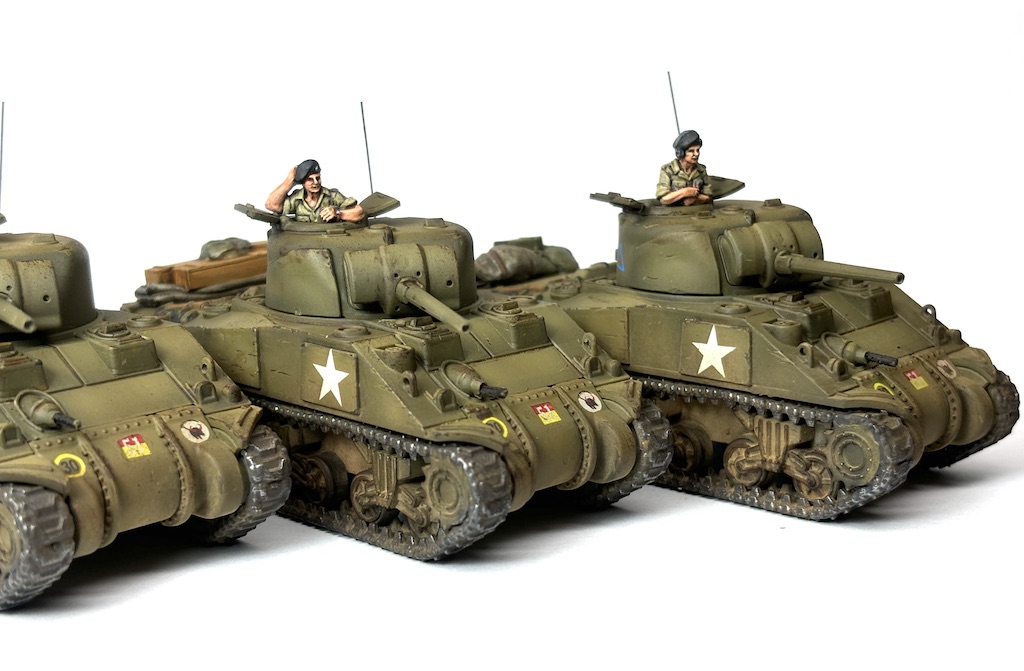
Sometimes the additions are planned and sometimes they are serendipitous. When I was visiting the Tank Museum at Bovington last year I came across a boxed set of PSC 1/72 M4A4 Shermans in the gift shop. These have been hard to track down of late and I've been eager to add more to my collection for the late war in Burma. The PSC models are sturdy gaming pieces, but that comes at a cost of chunky detail. I addressed some of that by drilling out the lifting hooks; replacing the bow MGs; drilling out the 75mm gun barrel and adding aerials.


The decision to purchase this set was partly influenced by the release of sets of decals in 20mm for Indian armoured brigades by District Miniatures. My only other Sherman for the Burma theatre made use of a few decals I could find in the spares box. 


After the initial base colours had been applied the new decals were added, before I moved on to painting details and weathering.


It has allowed me to draw on the inspiration from this book and have appropriately marked Sherman Vs for Burma.


If all that didn't make my decision easy enough, I had painted a set of AB tank crews for other vehicles in Burma and had several spare figures left over looking for suitable mounts. With the crews and stowage added, the tanks were complete.


I find I can be very productive with the airbrush when painting in batches. I've had a couple of PSC StuG III primed and waiting to be painted. As I'm playing the Old Hickory campaign at the moment I thought it wouldn't do any harm to have a few more StuGs to hand. I tried to give these quite a worn look and paid particular attention to making the side schurzen look chipped and worn.

The addition of foliage made from rubberised coconut fibre and model railway leaves gave it a particularly suitable appearance for German armour in Normandy.


When 172 Scale Miniatures had a 50% off sale I found it hard to resist the urge to fill a few gaps. It didn't help that I was playing a game in the Driving Charge campaign for Chain of Command and my opponent surprised me by taking three Type 97 Chi Ha as a support choice. I didn't have three of the early variant, I had only two of the old Airfix Chi Ha and one of the 172 Scale later model Shinhoto Chi Ha, which proxied for the missing earlier model. 
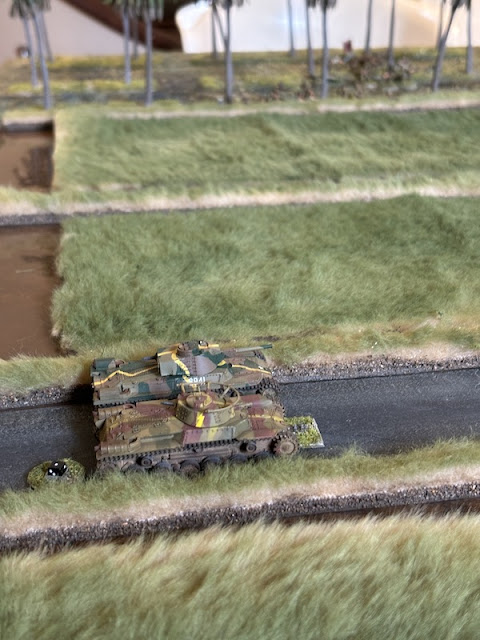
The sale at 172 Scale Miniatures was the perfect opportunity to make good this deficit. I knew the Airfix Chi Ha at 1/76 scale was unlikely to match those from 172 Scale Miniatures so I ordered three early model Chi Ha and then added another two of the Shinhoto versions to give me three of each type. Excessive? Probably, but I think it guarantees I'm covered should a similar situation arise.

Anyhow, did I mention I can be particularly productive with the airbrush when painting in batches?

The distinctive yellow lines over the Japanese camouflage was a feature of the early war and was no longer in use after 1942, so the Shinhoto versions I have painted in a late war three colour scheme. 

While I was researching the Saipan scenario for CanCon that I ran earlier this year, I discovered that quite a few Shinhoto tanks were used during the Japanese counterattack against the beachhead, so I didn't really need any convincing that this should be the subject of my scenario. Everything happens for a reason (at least that's how I convince myself all this makes any sense).

The colour scheme for the early model Chi Ha retained the yellow lines. From what I understand Japanese tanks were not repainted in the field and any tank still in service after 1942 was quite likely to retain those earlier markings, so that even if these were to appear in games set in the late war they wouldn't look out of place.

While painting those, I also completed a couple of diminutive Type 97 tankettes. These are from S-Model, plastic kits from China and a manufacturer who's products I like a lot. With two kits in a box they offer value, as well as a high degree of detail for a quick build model. 

This particular set comes with decals for the Chinese PLA which used captured versions, but I've painted them as Japanese with decals from Skytrex.

While air support does exist in Chain of Command, it is abstracted in the rules. There is no need to actually represent it on the table with models. However, that's never stopped me. Even since I built the Airfix Stuka to use in the AARs for our Many Rivers to Cross campaign I've wanted to find a way to incorporate models on the table to remind us that the effects of air support are in play. 

In the Far East I did something similar for the Zero Attack! for the Japanese.

And the Hurribomber for the British.

It goes without saying I was keen to do it for other forces. If nothing else, I find making aircraft an enjoyable diversion. While the Pacific Handbook for Chain of Command has yet to be released I find it hard to imagine the US Marines won't have access to some form of air support. I've always found the Corsair F4 an attractive looking plane, there is something quite elegant about the gull wings. With little encouragement needed I picked up an inexpensive 1/72 kit from Hasegawa. 

As I've done with the Zero I've modelled this without the propellor blades so that it doesn't look too static. I did experiment with discs of clear plastic to represent the spinning blades but they ended up looking like, well, discs of clear plastic. I think the impression of movement is just as obvious with nothing there.


While I was in the model shop I spotted a Mustang P51A, the earlier version before the bubble canopy was introduced. This kit from Italeri came with decals for the 1st Air Commando of the 10th Air Force, a unit that flew close support missions for the Chindits in Burma. That was just too tempting. I have written a campaign for the Chindits that exists in draft form, it may be that I need to revise that to introduce an element of air support now that I have a suitable aircraft.


Are any of these likely to see the table top in the near future? Quite possibly, but then I'm also a modeller at heart so I never need much of an excuse to add something new, even if there is no immediate need for it right now.