Tuesday, 6 January 2026

2025 - a gaming year in review

Well, it seems 2025 was a particularly productive year, something I hadn't quite realised until I started putting a retrospective together. Followers of the blog will know it was only a week ago that I posted a review of my Chain of Command related activities, but looking back at other rules and periods it dawned on me that there was more than enough to warrant a second post. Excuse the indulgence! 

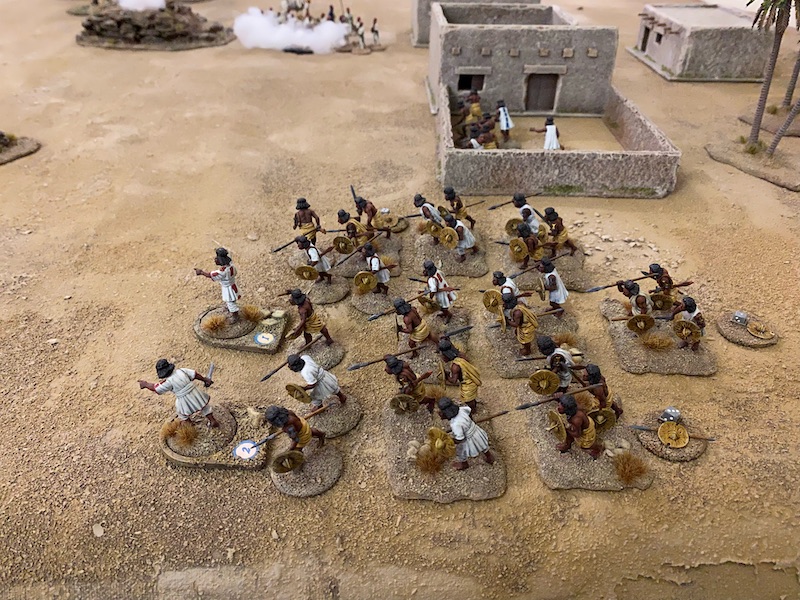
The biggest new painting project for the year was undoubtedly the German tribes for Infamy, Infamy. I didn't buy the figures during the year, which is partly why they became a 2025 project, they were long overdue painting. The vast bulk are from the Victrix plastic range, with shield transfers from Little Big Men Studios.

The few metal figures in the collection are from Wargames Foundry, like this group of wailing women.

As mentioned, the spur to paint the figures was to play games using Infamy, Infamy. My regular opponent Dave has quite a Roman collection and they were just awaiting suitable opponents. I wrote up a detailed report of one of our first games, which you can find in this post

The figures also featured in a number of games at the club.


I needed to add a small group of slingers to the German force and adapted those from a set of Gripping Beast Dark Age Warriors that I had lying around. Little did I know, but that decision would then lead me down a completely different rabbit hole. One thing led to another and within very little time I had a Saxon warband. A long story, but one you can follow in more detail in this post

This was inspired in part by our Dux Britanniarum campaign Warriors of the Old North. We played the first game at the tail end of 2024 and it continued into the first half of 2025 with another three games. 

All the figures came from Dave's collection, so there has never been a need for me to create an additional warband for this campaign. Well there you go, sometimes this hobby can lead you down all sorts of unexpected paths. 

When it came to basing those Saxons I did it with a number of rule sets in mind. That started me thinking about how I could use some of my existing figures for other periods for different rule sets. 

I have a number of Hundred Years War figures that were created with Lion Rampant in mind. While those rules were fine for a casual game at the club, I was keen to do something on a grander scale. I'd played my first game using Midgard in April. That was a big, multiplayer scenario set during the Trojan War and was very enjoyable. 

When I saw that James Morris had compiled lists for the Hundred Years War I looked to see if I had enough figures to put together a French and English force. I was close, but not quite close enough. What I did have, were a number of Perry plastic sprues that would provide me with enough figures. For a reasonably small investment of time I could add the various crossbow men, archers and men-at-arms to make up the numbers needed. 

The only other additional work was to make up a handful of suitably based figures to represent both French and English heroic leaders.


All that remained was to create suitably sized sabot bases of the standard 120mm Midgard width that would hold up to eight figures per unit.

Our first game used the lists for Agincourt. We decided to see how the rules would play out if we created a scenario that tried to mirror the actual battle. Anyone familiar with Agincourt will know that is likely to create a game with a decidedly English bias. Nonetheless, we thought it might be a good way to test out how well the rules replicated the historical situation. True to that narrative, the French struggled across the muddy ground to confront the English. Those that did make it across came to grief in front of the stakes set up by the archers. French courage was not lacking and their heroic leaders racked up a significant number of reputation points leading charges. While few fell in combat, the same cannot be said for the men they were leading, which ultimately assured English victory. 


That was a satisfying result, in so much as we felt the rules were able to give a plausible historical outcome. That inspired a second game, using the 'defend the hill' scenario in the Midgard rulebook. That delivered a more satisfying game, where the opportunities for victory were more evenly balanced and with the outcome only decided toward the very end. 

As it happens, the sabot bases also work for another set of medieval rules Blood and Horse Droppings by Rob Jones. I've played these before and as Rob is a medieval historian there's no surprise that these do a good job of focussing on the challenges of command in the period. Given I had the figures and bases it made sense to give the rules a run out again at the club.

Much comes down to decisions made by commanders as they enter or continue to fight in melee. As always with the period (and in common with Midgard), leadership and heroic deeds count for much. By the way, the rules are free and available as a pdf download from Rob's website Historian in Harness.

Having played a giant Trojan War game using the Midgard rules, our host also wanted to try doing something similar, but this time using Hail Caesar (or, as the detractors at the club like to call it 'Fail Caesar'). These were my first games using those rules and I have to say, they didn't grab me. Despite the game looking quite spectacular with hundreds of 28mm figures, I found the rules rather vanilla and the games not as engaging as Midgard.


O Group was a rule set that consumed many of my evenings at the club. We managed to play through both the France 1940 and the 1941-43 Eastern Front supplements. For these we used my opponent's large 15mm collection and terrain, most of which was amassed for Flames of War, but has since been repurposed for O Group

It's not a complex set of rules, but it does have a lot of nuances. We found it really benefited from repeat play and without keeping too long a gap between games.


We like the system, but we do have one gripe. That's with the scenarios and in particular the victory conditions. Despite setting objectives that can be captured, any game can also be won by inflicting a number of casualties on your opponent. As a result, we've often found the game coming down to our ability to pick off low hanging fruit to rack up those casualties, rather than a focus on capturing key objectives.


More recently we started playing the scenarios from the Normandy supplement, which was an opportunity to use my 12mm collection which I had created with O Group in mind. 

The 12mm collection also saw use at the club playing Crossfire, where I introduced the rules to a gamer I have known since my Advanced Squad Leader days.  


Despite the disparity in the size of their respective rule books, he found much to like about Crossfire's elegant simplicity. Talking of which, I've been using the elegantly simple 2'x2' introductory scenarios designed by friend of the blog Dick Bryant. It's been a very useful tool for taking people through the rules, whether they be new players, or those just inquisitive to discover how the rules play out. For those games I've been using my 20mm terrain and the multi-based figures I still have in 20mm for playing Crossfire (more about those here).

Playing games set during the American War of Independence using the Sharp Practice rules is of particular interest, but 2025 saw very little of that. Sadly, there's only so much game time available each year. However, that period was not entirely neglected. I was able to paint up three groups of ragged Continentals, a lovely set from Eureka Miniatures.

There was only a solitary game using Sharp Practice and that was set during the Peninsular War, not in the rebellious American colonies. However, there were no complaints from me. Once again, our host supplied a magnificent table and an equally magnificent selection of figures.


John Savage, the author of What A Cowboy, very kindly shared a draft version of his modern variant of those rules entitled What a Cartel (these have since been published in the 2025 Lard Magazine). It was an opportunity to dig out my rarely used figures and terrain for Afghanistan and we ran a simple extraction scenario, where a team of private military contractors attempt to save a downed helicopter crew.


Whilst not miniatures, I also played through the whole of an Undaunted: Stalingrad campaign with a good friend. He's an avid historian of the war and an equally enthusiastic player of board games, but any attempt I've made to entice him over to playing miniatures has failed. I've long since given up hope of bringing him over to the dark side, but that doesn't mean we don't continue enjoying gaming together.

So, another full year of gaming. It's funny really, because that's not how I felt about the year when I was first reflecting back. For some reason my mind focussed on the lost opportunities and disruptions. In hindsight these now seem minor and while a year with even more gaming would have been great, it would be churlish to complain. Huzzah for 2025.

Tuesday, 30 December 2025

Chain of Command in 2025

Previously, I've put together a post with a broad overview of my gaming year, but with the release of Chain of Command v2, I thought I'd narrow the focus for 2025 to look solely at what I've done that relates to Chain of Command.


The second edition is not so much a new set of rules as an evolution of the original. In fact, we found it a very smooth and seamless transition. There are several new mechanics and a few refinements of existing rules and they inspired the creation of suitable markers.

Now there is a need to keep a reminder of the remaining number of missions for a mortar bombardment. As forward observer figures are no longer required on the table, this was simply a matter of repurposing my original figures with the addition of a mini-dice frame so that we can count down the missions.


Replen points are a new addition and represent support options for extra supplies for weapons like the PIAT that have limited ammunition. The German marker below made use of a few spares from one of the Plastic Soldier Company sets, while the British one used a surplus ammunition carrier from AB Figures.

For the Japanese, I used an old Airfix figure and horse from their Jungle Outpost set.

For the Americans, I used spare figures from Simon's Soldiers.

The US 60mm mortar has limited ammunition, but deploys with an automatic Replent Point, effectively giving it six rounds. For that I included a mini-dice with a figure from AB so that it would be easier to track the number remaining.


The Germans have a support option for 'Mines in Verges'. While this is abstracted and doesn't require representation on the table, I thought I could make a marker that could serve as a reminder these are in effect. It was a good way to make use of an engineer with a hammer from one of the AB Figures sets that would otherwise have remained in the spares box.

One small change to the army lists is that the British platoon lieutenant and sergeant now come armed with a pistol and a rifle respectively. They can be upgraded to a Sten gun as a support option. Once again, I raided the spare box for suitable figures and based them as I do all my senior leaders. 


Talking of senior leaders, I carried out a simple conversion of an AB figure to make a wounded leader to act as a game marker to replace the original leader figure once they were wounded. 


That inspired me to raid the spares box once again and carry out a few conversions to create options for a few nationalities.


As always, there were other figure projects and additions. Whilst sorting through the spares box I also found a use for a few of the extra MG42 gunners from earlier projects. Normally, I base these as two men teams. I think if you don't base them as a pair then the figure loading the belts of ammunition looks a bit forlorn if not placed suitably next to the gunner. While that solves one issue, it creates another. When that figure is a casualty I have to use a marker to indicate the loss. As I have so many spare gunners it seemed logical to base a few of these individually to save adding clutter to the table when the team is reduced to a single man.


These are all from the Plastic Soldier Company German infantry set, but I thought I'd also do one in pea dot camouflage for the SS. As with so many of these additions, this wasn't a case of buying new figures, just raiding the spares box or converting existing. 


That said, there were some new figure purchases. Well, of course there was. I'd noticed while doing the game reports that nearly all my German figures are standing and the only prone figures were a few MG42 teams. AB Figures do a nice set for a prone section and so I added them to an order I was placing. 


That order also included a pair of Russian flamethrowers.


A set of British engineers clearing mines.


A crew for this Sexton from the Ready to Roll range.


A crew for a Fallschirmjager le18IG infantry gun from Zvedzda.


Later in the year, I placed a second order with AB later to fill a few more gaps, like these German snipers. It's a set of six and I've painted them in various schemes so that I can use them with the SS, regular Heer and Volksgrenadiers.


Also a pair of teams crewing tripod mounted MG42s. These were not so much filling gaps, rather they were replacements for my existing teams, which were my original Plastic Soldier Company figures.


There were more figures in that second order, but they are yet to see the paintbrush, so expect to see them in a future post in 2026. 

Unfortunately, I had a much more painful process with another order, although not from AB Figures, who have always been excellent. No, this was with Grubby Tanks. An order placed in January had failed to materialise. Despite some brief communication all went silent and any further attempts at contact came to nothing. By May I'd given up hope and so resolved the issue with a PayPal dispute and a full refund. The problem was, it wasn't about the money.....it was about the figures. 

I was eager to fill some gaps in my US Marines collection and the Kellys Heroes and Britannia Miniatures ranges sold through Grubby seemed to have what I wanted. It was at this point that friend of the blog Rob came to the rescue. Rob is UK based and offered to try to pick up what I needed at one of the shows. Cut a long story short - Rob was an absolute champion and by November the figures arrived here in Sydney. 

I wasn't able to paint them all, but was eager to do a few to see how well they fitted in with my existing Marines from Eureka.


Pleased to say they are a good match with similar sizes and sculpting style.


Last, but not least, I added a few extra junior leaders for the Fallschirmjager force, this time from Adler.


Looking back across the year, I seemed to have added a lot of British vehicles. An Airfix Churchill bridge layer was a gift from a relative that I hadn't seen an immediate use for and so it sat unmade for some time. 


I'm not sure it will ever see use in a game, but hey, you never know. I've also left the bridge unattached, that way it can be removed and used separately, which is the more likely outcome for a game setting. While that version of the Churchill might not see much tabletop action I had a more immediate need for a regular version of the tank for our Scottish Corridor campaign. I needed a second one for a game and surprised myself to discover, while I have lots of versions - AVRE, 90mm close support, Crocodile - I didn't have two regular versions. What I did discover was one from the Plastic Soldier Company tucked away in the paint queue. It was already made and primed, just waiting for paint. That was rectified very quickly.


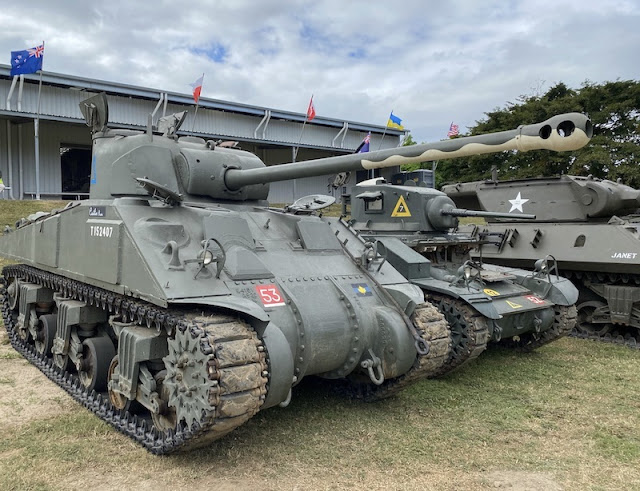
When I was back in England in late 2024 I paid a visit to the Tank Museum in Bovington. Always a worthwhile trip but this one had the added bonus of finding a box of Plastic Soldier Company Sherman M4A4 in their gift shop. Just what I was looking to add to my late war collection for Burma. Very serendipitous. They were made and painted this year with decals from the very good District Miniatures range.


Talking of the late war, the Comet was one British tank not in my collection. When Vespid released their 1/72 kit I was eager to get my hands on it, as I'm a big fan of their models. Here it is with two crew from AB Figures.


British armoured cars were also a feature this year. I picked up the old Hasegawa Daimler MkII kit very cheaply at a Bring & Buy. It was a quick and simple build.


The year was also a venture into more 3D prints. This very lovely Lanchester armoured car was from Dark Castle Terrain here in Australia (although I believe they print under licence for designs coming out of Ukraine).


Sabotag3D sell the stl files for the very unique armoured cars built locally for the Hong Kong Volunteer Defence Corps. This one was kindly printed for me by someone at the club.


Seeing a Pathe newsreel from Burma of a 5.5" gun firing over open sights at Fort Dufferin in Mandalay inspired me to pick up the venerable old kit from Airfix. 


The 5.5" was rarely used in a direct fire role, so it's not a weapon likely to feature in many games set at the scale of Chain of Command. That said, I do understand they were also used to do something similar in the Arakan campaign, so you never know. I guess that means that at some stage I'm going to need to add a crew....


These two M3 75mm GMC are from Italeri and were additions to my US Marines. They have already seen action, featuring in the Saipan scenario I ran at Cancon earlier in the year.


A couple of unpainted Plastic Soldier Company StuGs were also sitting in the paint queue and they were a refreshing change from painting in British Olive.


Every now and then I feel the urge to make aircraft models. While air support does feature in Chain of Command, the effect is abstracted and there's no need to actually represent the aircraft on the table. But you can, if you want. Naturally, I want. However, I think I may have gotten a bit carried away this year, but sometimes it's just good to have a change.

These are all 1/72 plastic kits. First up, a Hurribomber for Burma.


You'll notice that I've removed the propellor blades from all of the flying models. I think this looks more effective in the game report photographs, giving a much better impression of flight than if the blades are static.


The British used their lend lease Thunderbolts only in Burma and so, why not add another plane?


It gets worse. I added a second Thunderbolt, this time an earlier razorback version. Tragic, I know.


Staying with Burma, the US Air Commando operated Mustangs in ground support for the Chindits. Well, that was all the excuse I needed....


Naturally, the US Marines would need something to represent their carrier-borne air support and I do love the look of a Corsair. And, let's be honest, how often do you get to paint something blue for the Second World War?


I couldn't let the Far East steal all the glory, surely there will be a time to represent British close air support in NW Europe? I stumbled across this very reasonably priced Academy Tempest and was tempted.


Before I forget, I also made a crashed Japanese Zero as a scatter piece for the Pacific and Far East.


Talking of terrain pieces, there were a few new additions here as well. I picked up a resin bunker in a Bring & Buy. It is supposedly for 28mm, but I figured it actually sat somewhere in between 28 and 20mm. So much so, I've used it for my 28mm First World War games as well as my 20mm Second World War games.

I bought this Warbases Far East building in a sale from 172 Scale Miniatures. Interestingly, it's not available from Warbases in 20mm, so must have been created especially for 172. As I've done with my other Far East huts, I've clad the exterior and roof using textured craft papers. You can see more about those in this post.


How I go about doing this was also the subject of an article I wrote for one of the issues of Wargames, Soldiers & Strategy magazine (#137) published during the year.


The decision to embark on the Westwind Konigsberg campaign inspired me to address the lack of German style buildings in the collection. Too often my 'German' tables have looked a lot more like Normandy than anywhere else, so this was long overdue. The buildings are from Sarissa and there's a longer blog post here on how I made them.


While not actually German, these Russian Townhouses below, also from Sarissa, have a look that could work for Russia as well as many other places in eastern Europe. They're a very useful addition and have already been used to represent buildings in East Prussia.


I combined them with the French chateau from Sarissa to try to recreate the girls' school near Metgethen for the Westwind Konigsberg campaign.


While it's all very well and good collecting terrain, figures and models, I wouldn't want to lose sight of the purpose, which is of course, playing the actual games. 

The year started when I ran four participation games of a Saipan scenario at Cancon using my US Marines. Lots more about it in a post from January that you can find here.


Guy Bowers, the editor of Wargames, Soldiers & Strategy magazine, asked if I'd like to write up the scenario for a future edition of the magazine and it made an appearance in issue No138.


As always, there were pint sized campaigns to play. Readers will be familiar with those I play against my regular opponent Dave, all of which are documented here on the blog. This year featured only the Scottish Corridor campaign, a continuation of the linked campaign with Operation Martlet. We played out eleven games, with Dave's Germans earning a hard fought campaign victory.


Last year I taught a friend to play Chain of Command and ever since then we've been playing regular weekend games and running through several of the pint-sized campaigns. Other than A Driving Charge I haven't been documenting these on the blog, but this year we have managed to play through a few more.

The first was A Green and Brown Hell, a Hurtgen Forest campaign published in the 2024 Lard Magazine. Featuring tables dominated by forest, this was something of a terrain challenge and not too dissimilar from trying to create jungle tables. I think I found a reasonable balance between dense yet playable terrain.


We stayed with a late war theme in the second campaign of the year, but moved our attention to the Eastern Front with the Westwind Konigsberg campaign. This was where the recently made German buildings made their first appearance on the table top. 


Last year Dave and I played through a short mini-campaign that I had devised about the actions on Nunshigum Ridge during the battle for Imphal in 1944 (the game reports for that are on the Campaign AAR page). I'm pleased to say that was published in the 2025 Lard Magazine and so is now widely available.


All in all, a very productive year in Chain of Command terms. Of course, that doesn't mean I wasn't playing or painting anything else. There's enough there for another post in itself. Let's hope 2026 can be equally productive and rewarding.

Lastly, I want to wish all readers the very best for the coming year. Many thanks for following along with the blog, making comments and/or buying me a coffee - it is all very much appreciated.