With a gap between campaigns for Chain of Command, I've filled the last few weeks playing a range of different rulesets - some old, some new and some with a refreshed look after rebasing.
As always, our weekly club is something of a gaming laboratory for me - a chance to try different periods and rule sets. Often those don't go beyond an initial trial game, nonetheless I feel it's well worth keeping abreast of what's happening in the hobby. It's a lesson I learned many years ago after allowing myself to become totally absorbed in playing Advanced Squad Leader. I invested so much in learning and playing that system I ignored what else was happening in game mechanics and system for the Second World War. When I finally surfaced for air it was to discover I had let a number of great new innovations and developments pass me by. While I don't look on those as wasted years, I don't intend blinkering my gaming like that again.
I have a collection of 28mm Hundred Years War figures that don't see as much game time as I would like. Initially I put them together for Lion Rampant, as that was a popular club rule set. I don't mind the system for a quick pick up game on a club night, but it doesn't really scratch my itch for either larger battles or the more lower level skirmishes that were very common in the period.
To play larger HYW battles I decided to try Midgard. I'd played it once before as part of a multiplayer game on a huge 18' table set during the Trojan War. It goes without saying, that was enough to convince me the rules worked for large battles.
While I had no intention of stretching my HYW collection to anywhere near the number of figures in that game, I still didn't have enough painted figures to run something much smaller. Fortunately, the lead pile had the additional numbers I needed. That called for a bit of painting and the creation of sabot bases that conformed to the standard base size for Midgard.
With those completed we tested the rules by running a couple of games with an Agincourt theme. For the first we tried to create something close to the historical conditions of the battle itself. It was intended to trial how well the rules could replicate the period, in this case one where we know a fair bit about the battle.
It goes without saying the scenario was unbalanced, with a strong English bias. The French were channelled into a narrow area, having to cross muddy ground to reach the English positions. Historical? Yes. Fun? Well, surprisingly, despite a predictable outcome, it proved an enjoyable game that was not entirely one-sided. I certainly liked the emphasis on heroic leadership and the importance of reputation, that seemed most appropriate to the age.
Staying with larger battles, we also tried a set of rules by medieval historian Rob Jones, entitled Blood & Horse Droppings. This worked with similar basing to Midgard, which proved very convenient. However, unlike Midgard, these rules confine themselves to a fairly specific historical period, reflecting the author's area of study. No surprise then, it has a strong feel for the 14th and 15th century. Like Midgard, much emphasis is placed on the importance of leadership, but in the case of Blood & Horse Droppings this has a very specific focus on melee, where the player is making the decisions of individual commanders in the lead up to contact and during the fight itself. An opposed play of secret melee action cards introduces a nice fog of war - how will your opponent greet your charge? With a step back to absorb the impact or will their leader risk all in an aggressive push forward?
Having enjoyed the rules I decided to back the publication of
Ecorcheurs, a set of medieval skirmish rules, also written by Rob Jones and published by Gripping Beast. As opposed to a large battle, this set of narrative based, scenario rules focuses very much on the small fights between raiding retinues and uses individually based figures.
It incorporates much that I like in skirmish rules using a very interactive sequence of play with no determined turns. It's a mechanic that gives the play some of the feel of Crossfire, where initiative passes frequently between opposing players.
Movement is variable, without being random and leadership plays a key role in the effectiveness of a retinue.
I enjoyed the system and will certainly play it again, but that sets up a dilemma. As readers of the blog will know, I've only recently moved away from single figure basing and sabot bases to multi-basing. Now I have a strong urge to do this with my Hundred Years War figures, which of course would mean they won't be suitable for a system like Ecorcheurs. Well, never say never, there may yet be a solution, although right now I have no idea what that might be. Whatever it is, I have a feeling it probably entails painting more figures.
Jumping ahead a few centuries, I've managed to get around to painting some of the plastic Perry Afghan irregulars for the late Victorian era. Originally I bought two boxes when I was putting together figures for my Sudan project. There was a logic to the purchase at the time. I already have Afghan buildings in 28mm that I created for more modern games.
Not only that, the British for Sudan will also work for the North West Frontier/Afghanistan.
In that sense, it wasn't such a stretch to consider creating a force of Afghans. Sadly, the figures languished unpainted for more time than I intended. No longer. I have to say this has fast become one of my favourite Perry plastic sets. The sculpting is very good and the options for poses creates some very atmospheric sets of figures.
As I've done for my Mahdist and other irregular type units, I've opted for 3,2,1 basing to avoid that more uniform look of regular troops.
There is more painting still to do (sheesh, I bet no wargamer has ever said that before), but at least the project is a work in progress.
I have a few Perry plastic British left over from the Sudan project and so I decided to paint those as the 72nd Foot during the Second Anglo Afghan War. I really liked the combination of tartan trousers and khaki jackets. There is something anachronistic in the combination, one that looks to the future while keeping an eye on the past. I also based them more as skirmishers in open order than in rigid lines, something more appropriate for some of the actions in this period.
I'm still considering a few different sets of rules, but a couple of people at the club are inclined to explore what options there are to further modify
Sharp Practice, drawing inspiration from John Savage's Sudan variant that took the rules into the breech loading period. However, there are several other sets out there, so I'm keeping my mind open.
Talking of Sharp Practice, I've managed to play several games set within its more traditional horse and musket period. In my case, that's the American War of Independence. The scenarios have all been set during the early stages of the war, inspired by accounts from the battles to capture New York.

This has been an opportunity to use my rebased figures and the new cards I've created (see my last two posts here on the blog for more on those).

The one issue that needs addressing with multi basing is how to handle casualties. I have a few ideas that I'm trialling and the games have been a good opportunity to assess what works best. While all of those ideas work, I'm not convinced I've found the answer yet.
That's not a problem with the skirmishers and light infantry, as I've based those using 3,2,1. That helps handle casualty removal, but also allows them to fit more naturally into the terrain they are most likely to occupy during a game.
The issue of marking casualties aside, I'm really preferring the look of the multi based units, there's a compactness to the figures that gives a much more atmospheric appearance to the table.
I've yet to be convinced Muskets & Tomahawks is a rule set that gives me the same sort of game for this period as Sharp Practice. I wrote a long blog post three years ago where I compared the two. Once again the club allowed me to give M&T another try, this time with a French & Indian War setting.
I think my biggest issue with this game was the relatively short movement distances. I never felt any sense of jeopardy from enemy movement. Even with a few consecutive card plays they were never going to move far enough or fast enough to really throw me off balance. Rather than a game of manoeuvre this became a game about firefights. There was a definite shortage of drama as each player had enough time to counter the other's moves. The rules aren't broken, but they just don't deliver the sort of historical game I like.
Another club game used a draft set of Napoleonic rules for brigade level battles that were condensed into two pages (and no, it wasn't Valour & Fortitude). These were written by a local gamer and were simple, yet elegant. Proof that it's not quantity, but quality that makes a good rule set.
They also allowed us to play a good size encounter in an evening. The game was fun and historical, probably more fun than historical, but not so wide of the mark to make us dismiss them out of hand. As someone at the club said, 'Napoleonic rules tend to be either fun
or historical'. They may have a point and while these weren't the panacea there was enough to commend them.
I don't know whether it was because the figures had an old school look, or whether the rules had an old school feel, but there was something about the game that harked back to an earlier time in the hobby.
All that has kept me busy, but it doesn't mean I have totally neglected Chain of Command. While I still have to work out how Dave and I will continue the campaigns I record here on the blog, particularly solving the lighting for photography, that doesn't mean I can't play games in the meantime. In this case my current opponent is not Dave, but a friend I introduced to CoC a couple of years ago. He lives nearby and we often plan a game for a Saturday morning.
At the moment we are playing the Bazooka Town campaign from one of the Lard Magazines. A late war campaign set in Germany (as in very late war - April 1945), with US armoured infantry pushing into the Fatherland.
So far, my panzer grenadiers are hard pressed. Their platoon is brittle and the US armoured platoon packs a mighty punch.
Even when the Americans present a bunched target this close to a river crossing, they returned all German fire with a vengeance. It's early days in the campaign and we will soon reach a point where the panzer grenadiers dig in their heels and make a stand.
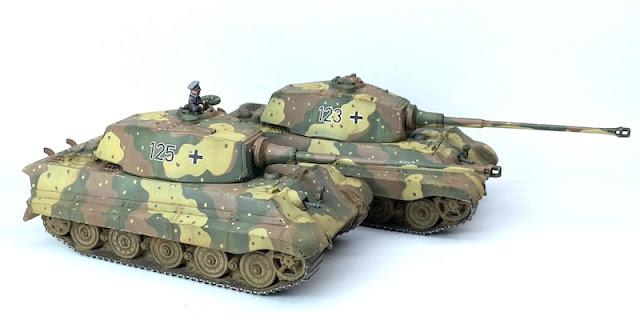
Perhaps what makes the campaign so attractive for the German player is the option to mount a counter attack with a force supported by two Tiger IIs. Now, that doesn't occur very often in Chain of Command but, as it happens, I have a couple of models ready to hit the table.....